
The How’s and Why’s of Businesses in Transforming to Private Cloud Platform
The manner in which organizations manage data and applications keeps on changing as the organizations further immerse in the digital transformation. The most visible tip of this change is a private cloud platform that allows companies to gain control over their own infrastructure. And, they will enjoy the flexibility of cloud computing. Firms intending to transform to private cloud platform have an opportunity to discover new heights of security, performance and operational efficiency. All of which is not achievable by conventional hosting models.
In the world of data volumes and of regulatory requirements, a transition to a private cloud platform is no longer a luxury, but a necessity.
What Is a Private Cloud Platform?
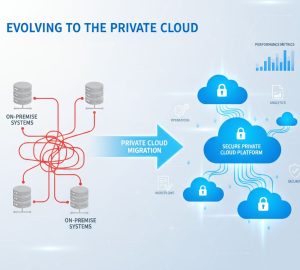
A private cloud platform can be defined as cloud infrastructure which is allocated specifically to one organization. In contrast to the public cloud services, which share resources with several customers, the private cloud environments provide isolated resources in computing, storage, and network. This isolation also provides businesses with a high level of performance, security, and compliance control.
Private cloud platforms may be implemented in-house or contracted by a third service provider. What is especially interesting about them is the fact that they manage to unite the advantages of cloud computing. It includes scalability, automation, and the governance and control of traditional infrastructure.
Why More Organizations are Opting to Convert to Private Cloud Platform
Here are the reasons behind the transition of some organizations into a private cloud system:
1-Greater Data Protection and Security
Security is among the most important concerns of any business, which deals with sensitive information. The private cloud platform provides your organization with the control over its data infrastructure in full. The lack of sharing resources with other entities due to this lowers the impact of external risk. It can also help to comply with stringent regulatory requirements.
With information security as a priority in areas such as finance, healthcare, and government, a privatized cloud structure is used. The goal is to provide customized security architecture that cannot be achieved in a shared environment.
2-Personalized Performance and Customization
Comparably, the public cloud setting focuses on the performance that has to be looked into to ensure the performance of numerous tenants. Meanwhile, the private cloud systems are designed to accommodate the usage pattern of a particular organization. This capability of maximizing network settings, processing capacity, and storage enables it to support applications that have high demand. It covers enterprise resource planning (ERP), analytics workloads, and custom software systems.
This is particularly beneficial to companies in which steady operation and performance are critical to business continuity.
3-Scalability and Cost Effectiveness
Although the implementation of the private cloud infrastructure might demand higher initial investment, it is long term profitable. It will help in removing the costs and restrictions that are recurring in the public cloud levels. In the long term, the private cloud platform may provide a stronger cost forecast especially to entities with high and constant workloads.
In addition, the private cloud infrastructure can be scaled as an organization increases its operations. This is regardless of additional users, services, or geographies without any loss of control or security.
How to Successfully Transition to Private Cloud Platform
The process of switching to the use of a private cloud platform, instead of either the traditional servers or public cloud service, may look overwhelming. Yet, an organized strategy makes the process quite easy and successful.
1-Determine Present Infrastructure and Future Requirements
Start by auditing your current systems, deciding workloads, dependencies and performance requirements. Knowing what you already possess assists you in coming up with a private cloud environment that addresses actual rather than presumed requirements.
2-Develop a Migration Roadmap
An action plan gives the order of steps required to migrate applications and services to the private cloud. Assign workloads that can be best met by isolation and control. Schedule transitional actions to reduce downtimes in using your private server.
3-Embark on Security and Governance
The issue of security has to be built-in. This encompasses access controls, encryption, monitoring and compliance frameworks in order to ensure that your private cloud does not merely correspond with. But, it guarantees that it actually transcends the security posture of your organization.
4-Monitor and Optimize
Monitoring and optimization after deployment is used to keep efficiency and performance. Analyze bottlenecks to deploy resources according to the changing organizational needs.
End Notes
The decision to make the transition of using a private cloud platform in a more digitalized world displays resiliency, performance, and strategic development. Regardless of the objective of your organization, the technology of a private cloud can give your organization a strong base of innovation in the future. It could either be of secure data management, custom computing environments, or future scalability.
You will be able to develop an infrastructure that could meet both the present demands and future opportunities. Just make sure that you are employing the best practices and planning of each stage of your transition.